---
title: "Dock Scheduling Software: Boost Dock Efficiency | Opendock"
description: See six proven ways dock scheduling software cuts wait times, detention fees, and dock congestion for faster warehouse flow.
image: https://blog.opendock.com/hubfs/Dock%20Scheduling%20Software.png
---
[](https://blog.opendock.com/)
[](https://blog.opendock.com/)
- [Home](https://blog.opendock.com/)
- [Carrier Login](https://carrier.opendock.com/app/login)
- [Warehouse Login](https://nova.opendock.com/login)
More results
En
- English
- [Español](https://blog.opendock.com/es)
- [Español - México](https://blog.opendock.com/es-mx)
- [Português - Brasil](https://blog.opendock.com/pt-br)
- [Home](https://blog.opendock.com/)
- [Carrier Login](https://carrier.opendock.com/app/login)
- [Warehouse Login](https://nova.opendock.com/login)
Opendock Blog
#### Share this
[Share on X](https://x.com/intent/post?url=https://blog.opendock.com/dock-scheduling-software&text=Dock+Scheduling+Software%3A+Boost+Dock+Efficiency+%7C+Opendock) [Share on Facebook](https://www.facebook.com/sharer/sharer.php?u=https://blog.opendock.com/dock-scheduling-software&t=Dock+Scheduling+Software%3A+Boost+Dock+Efficiency+%7C+Opendock) [Share on LinkedIn](https://www.linkedin.com/shareArticle?mini=true&url=https://blog.opendock.com/dock-scheduling-software&t=Dock+Scheduling+Software%3A+Boost+Dock+Efficiency+%7C+Opendock)
# How Dock Scheduling Software Dramatically Boosts Efficiency
by [**Lauren Platero**](https://blog.opendock.com/author/lauren-platero) on 04 September, 2025
Key Takeaways
- Dock scheduling software cuts truck wait times and detention fees.
- Balanced dock-door scheduling prevents congestion and conflicts.
- Real-time visibility shifts dock teams from reactive to proactive.
- Predictable appointments boost carrier satisfaction and compliance.
The old way of scheduling through calls and emails no longer keeps up with the demands of modern supply chains. Fortunately, [dock scheduling software](https://opendock.com/en/products/dock-scheduling/) cuts wasted time, reduces errors, and gives warehouses control over dock flow. Here's how it works and where the gains show up.
[](https://lp.opendock.com/dock-scheduling-ebook)
## **How Does Dock Scheduling Software Boost Efficiency?**
**Dock scheduling software boosts efficiency by replacing manual coordination with a centralized platform that automates appointments, dock assignments, and carrier communication.** When docks run smoothly, the entire supply chain feels the difference. Here are six proven ways it delivers measurable operational gains:
### 1. Reduces Truck Wait Times and Detention Fees
**Long delays at the dock don't just frustrate drivers; they also cost everyone time and money.** Dock scheduling software solves this by keeping arrivals matched to open doors. Trucks get in and out faster, cutting [receiving dock turnaround times](https://blog.opendock.com/turnaround-times), and warehouse teams keep pace while carriers benefit from faster cycles.
Shorter waits open capacity so more freight can move through in the same window, which keeps [detention fees](https://blog.opendock.com/detention-fees-vs-demurrage-charges-dock-scheduling) to a minimum. When appointments stay on track and there is little to no idling, charges slow down significantly.
### 2. Improves Dock Door Utilization and Prevents Conflicts
**Underused or overloaded dock doors waste time and space.** Scheduling platforms balance appointments across all available doors so no dock sits idle while another is overloaded. This prevents congestion and creates smoother handoffs between inbound and outbound loads. By keeping utilization high and consistent, warehouses maximize throughput and improve daily flow.
Just as importantly, dock appointment systems remove the guesswork by coordinating all arrivals in one centralized schedule. Following proven [dock scheduling best practices](https://blog.opendock.com/dock-scheduling-best-practices) means no more double-booked doors, fewer scheduling clashes, and a dock that runs on time, keeping teams focused on execution instead of untangling mistakes.
### 3. Enhances Real-Time Visibility
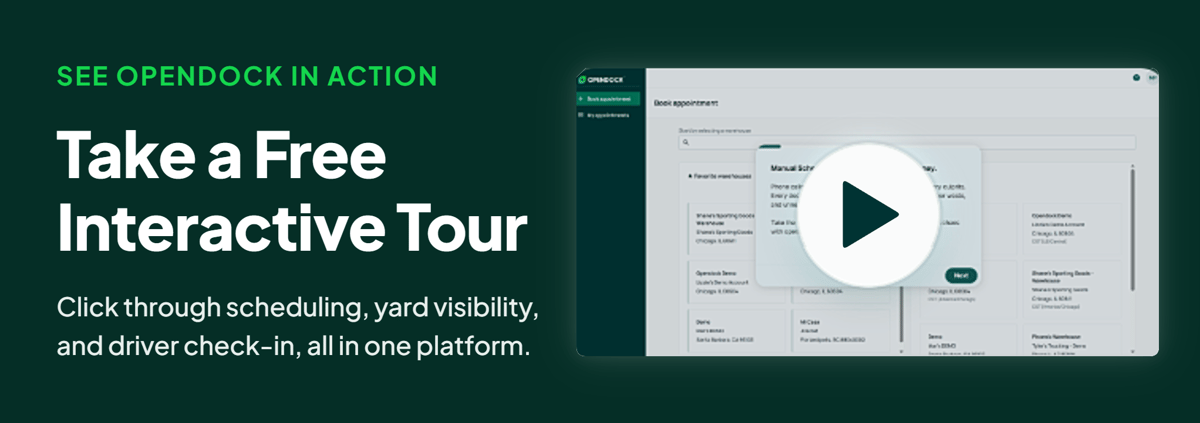
**When managers have real-time visibility, the dock shifts from reactive to proactive.** Every truck, every schedule, and every move is clear. Supervisors can reassign staff, redirect trucks, and avoid last-minute scrambles that drive up overtime labor. Cold-storage provider [SnoTemp replaced unreliable spreadsheet scheduling](https://blog.opendock.com/case-study-snotemp) with Opendock across three facilities, and now displays the live schedule on screens at the docks so workers can check a load's status without radioing the office.
[](https://loadsmart.navattic.com/904j01ru?g=cmm0qo58p004d04l16aswd4fk&s=1)
### 4. Optimizes Yard Traffic Flow
**In a congested yard, drivers get frustrated while warehouse teams scramble to adjust.** Dock scheduling software prevents logjams by staggering arrivals and directing traffic to the right doors at the right time. The result is a yard that moves in sync with the dock, and pairing scheduling with [yard management](https://opendock.com/en/products/yard-management/) extends that visibility to every trailer on site.
### 5. Avoids Chargebacks
**Retailers fine suppliers for late or noncompliant deliveries.** Scheduling software enforces appointment rules to keep deliveries within their windows and reduce costly penalties. That means fewer chargebacks and more trust with retail partners.
### 6. Improves Carrier Satisfaction
**Carriers value docks that respect their time.** Long waits and unclear instructions strain relationships and drive up costs. Dock scheduling software improves the carrier experience by creating predictable schedules and transparent communication. Drivers know when to arrive and where to go. Reliable scheduling makes your dock a preferred stop and strengthens long-term partnerships.
## **Operate an Efficient Warehouse with Opendock**
Manual scheduling leads to delays, disputes, and wasted labor. Opendock streamlines dock scheduling with real-time inbound and outbound visibility and automated booking. Request a demo to see how much time and money your facility can save.
[](https://opendock.com/#request-a-demo)
## **Frequently Asked Questions**
### How Do I Coordinate Dock Schedules Across Multiple Warehouses?
**Put every warehouse on one centralized scheduling platform so managers can see appointments and dock use across all facilities.** This makes it easier to coordinate carriers, balance workloads, and standardize operations across your entire network.
### Is Dock Scheduling Software Suitable for Small Warehouses?
**Yes, small warehouses often see big gains from dock scheduling software.** It replaces manual calls and spreadsheets, freeing staff time while keeping operations organized and predictable.
### What Features Should I Look for in Dock Scheduling Software?
**Look for features that simplify scheduling and improve visibility.** Think centralized calendars, appointment rules, and real-time updates. The best systems make coordination clear, reduce errors, and keep freight moving efficiently.
Topics: [Dock Scheduling](https://blog.opendock.com/tag/dock-scheduling)
#### Share this
[Share on X](https://x.com/intent/post?url=https://blog.opendock.com/dock-scheduling-software&text=Dock+Scheduling+Software%3A+Boost+Dock+Efficiency+%7C+Opendock) [Share on Facebook](https://www.facebook.com/sharer/sharer.php?u=https://blog.opendock.com/dock-scheduling-software&t=Dock+Scheduling+Software%3A+Boost+Dock+Efficiency+%7C+Opendock) [Share on LinkedIn](https://www.linkedin.com/shareArticle?mini=true&url=https://blog.opendock.com/dock-scheduling-software&t=Dock+Scheduling+Software%3A+Boost+Dock+Efficiency+%7C+Opendock)
- Recent
- Topics
- Archive
Recent
Topics
- [Dock Scheduling (38)](https://blog.opendock.com/tag/dock-scheduling)
- [Gate Management (22)](https://blog.opendock.com/tag/gate-management)
- [YMS (18)](https://blog.opendock.com/tag/yms)
- [AI Warehouse Automation (17)](https://blog.opendock.com/tag/ai-warehouse-automation)
- [Case Study (17)](https://blog.opendock.com/tag/case-study)
- [AI Dock & Yard (16)](https://blog.opendock.com/tag/ai-dock-yard)
- [Pharmaceutical Logistics (16)](https://blog.opendock.com/tag/pharmaceutical-logistics)
- [Data Centers (12)](https://blog.opendock.com/tag/data-centers)
- [Opendock Blog (12)](https://blog.opendock.com/tag/opendock-blog)
- [Beverage Industry (10)](https://blog.opendock.com/tag/beverage-industry)
- [Reverse Logistics (10)](https://blog.opendock.com/tag/reverse-logistics)
- [SmartGate + Theft Prevention (10)](https://blog.opendock.com/tag/smartgate-theft-prevention)
- [Warehouse (8)](https://blog.opendock.com/tag/warehouse)
- [Digital BOL (7)](https://blog.opendock.com/tag/digital-bol)
- [Opendock (7)](https://blog.opendock.com/tag/opendock)
- [Shipper (7)](https://blog.opendock.com/tag/shipper)
- [CTPAT (4)](https://blog.opendock.com/tag/ctpat)
- [Dock Management (4)](https://blog.opendock.com/tag/dock-management)
- [Driver ID Validation (4)](https://blog.opendock.com/tag/driver-id-validation)
- [Podcast (4)](https://blog.opendock.com/tag/podcast)
- [Cargo Theft (3)](https://blog.opendock.com/tag/cargo-theft)
- [ShipperGuide TMS (2)](https://blog.opendock.com/tag/shipperguide-tms)
- [Asset (1)](https://blog.opendock.com/tag/asset)
- [Award (1)](https://blog.opendock.com/tag/award)
- [Blog (1)](https://blog.opendock.com/tag/blog)
- [Brokerage Services (1)](https://blog.opendock.com/tag/brokerage-services)
- [Data (1)](https://blog.opendock.com/tag/data)
- [Events (1)](https://blog.opendock.com/tag/events)
- [Opendock Index (1)](https://blog.opendock.com/tag/opendock-index)
- [PO Validation (1)](https://blog.opendock.com/tag/po-validation)
- [Thought Leadership (1)](https://blog.opendock.com/tag/thought-leadership)
- [eBooks (1)](https://blog.opendock.com/tag/ebooks)
See all
Archive
- [October 2026 (5)](https://blog.opendock.com/archive/2026/10)
- [September 2026 (1)](https://blog.opendock.com/archive/2026/09)
- [August 2026 (30)](https://blog.opendock.com/archive/2026/08)
- [July 2026 (1)](https://blog.opendock.com/archive/2026/07)
- [June 2026 (34)](https://blog.opendock.com/archive/2026/06)
- [May 2026 (11)](https://blog.opendock.com/archive/2026/05)
- [April 2026 (20)](https://blog.opendock.com/archive/2026/04)
- [February 2026 (48)](https://blog.opendock.com/archive/2026/02)
- [January 2026 (1)](https://blog.opendock.com/archive/2026/01)
- [November 2025 (1)](https://blog.opendock.com/archive/2025/11)
- [October 2025 (16)](https://blog.opendock.com/archive/2025/10)
- [September 2025 (7)](https://blog.opendock.com/archive/2025/09)
- [August 2025 (17)](https://blog.opendock.com/archive/2025/08)
- [July 2025 (3)](https://blog.opendock.com/archive/2025/07)
- [June 2025 (4)](https://blog.opendock.com/archive/2025/06)
- [April 2025 (1)](https://blog.opendock.com/archive/2025/04)
- [March 2025 (1)](https://blog.opendock.com/archive/2025/03)
- [February 2025 (2)](https://blog.opendock.com/archive/2025/02)
- [October 2024 (1)](https://blog.opendock.com/archive/2024/10)
- [August 2024 (1)](https://blog.opendock.com/archive/2024/08)
- [November 2023 (1)](https://blog.opendock.com/archive/2023/11)
- [October 2023 (2)](https://blog.opendock.com/archive/2023/10)
- [August 2023 (1)](https://blog.opendock.com/archive/2023/08)
- [May 2023 (2)](https://blog.opendock.com/archive/2023/05)
- [March 2023 (1)](https://blog.opendock.com/archive/2023/03)
- [February 2023 (2)](https://blog.opendock.com/archive/2023/02)
- [January 2023 (6)](https://blog.opendock.com/archive/2023/01)
- [July 2022 (1)](https://blog.opendock.com/archive/2022/07)
- [May 2022 (1)](https://blog.opendock.com/archive/2022/05)
- [March 2022 (1)](https://blog.opendock.com/archive/2022/03)
- [August 2021 (1)](https://blog.opendock.com/archive/2021/08)
See all
### Subscribe by email
#### **About Opendock**
Opendock is a simple and powerful cloud-based dock scheduling software for warehouses that want to improve dock performance. By connecting shippers, carriers, brokers to the same online scheduling platform, warehouses can reduce detention fees, labor costs, and time spent on phone calls and emails.
Product
- [Carrier Login](https://carrier.opendock.com/app/login)
- [Warehouse Login](https://nova.opendock.com/login)
- [Support](https://opendock.com/support/)
- [Request a Demo](https://opendock.com/#request-a-demo)
Resources
- [ROI Calculator](https://opendock.com/#roi-calculator)
- [Community](https://community.loadsmart.com/hc/en-us/categories/14812430603411-Warehouses)
- [Developers API](https://developer.loadsmart.com/docs/opendock/overview/getting-started/)
Opendock is Powered by Loadsmart Inc. © 2026 - All rights reserved. SOC2 Type II.
- [Terms and Conditions](https://loadsmart.com/subscription-and-professional-services-agreement/)
- [Privacy Policy](https://loadsmart.com/privacy-policy/)
- [Security](https://lp.loadsmart.com/security)
```json
{
"@context" : "https://schema.org",
"@type" : "BlogPosting",
"author" : {
"@type" : "Person",
"name" : "Lauren Platero",
"url" : "https://blog.opendock.com/author/lauren-platero"
},
"dateModified" : "2026-10-12T15:08:42.613Z",
"datePublished" : "2025-09-04T16:48:09.000Z",
"headline" : "Dock Scheduling Software: Boost Dock Efficiency | Opendock",
"image" : [ "https://blog.opendock.com/hubfs/Dock%20Scheduling%20Software.png" ],
"mainEntityOfPage" : {
"@id" : "https://blog.opendock.com/dock-scheduling-software",
"@type" : "WebPage"
},
"publisher" : {
"@type" : "Organization",
"logo" : {
"@type" : "ImageObject",
"url" : "https://blog.opendock.com/hubfs/ls-logo.png"
},
"name" : "Loadsmart"
}
}
```
```json
{
"@context" : "https://schema.org",
"@type" : "FAQPage",
"mainEntity" : [ {
"@type" : "Question",
"acceptedAnswer" : {
"@type" : "Answer",
"text" : "Put every warehouse on one centralized scheduling platform so managers can see appointments and dock use across all facilities. This makes it easier to coordinate carriers, balance workloads, and standardize operations across your entire network."
},
"name" : "How Do I Coordinate Dock Schedules Across Multiple Warehouses?"
}, {
"@type" : "Question",
"acceptedAnswer" : {
"@type" : "Answer",
"text" : "Yes, small warehouses often see big gains from dock scheduling software. It replaces manual calls and spreadsheets, freeing staff time while keeping operations organized and predictable."
},
"name" : "Is Dock Scheduling Software Suitable for Small Warehouses?"
}, {
"@type" : "Question",
"acceptedAnswer" : {
"@type" : "Answer",
"text" : "Look for features that simplify scheduling and improve visibility. Think centralized calendars, appointment rules, and real-time updates. The best systems make coordination clear, reduce errors, and keep freight moving efficiently."
},
"name" : "What Features Should I Look for in Dock Scheduling Software?"
} ]
}
```