
Share this
by Lauren Platero on 24 February, 2026
Key Takeaways
- Opendock builds BOL signing into the gate workflow, not a separate tool.
- Each BOL is attached to the dock appointment the carrier already booked.
- Drivers sign at checkout on a facility tablet or their own phone.
- Signed copies flow back to your WMS or TMS through the API and webhooks.
A bill of lading (BOL) is the core shipment document that records what's being shipped, where it's going, and who's responsible for it. For years, managing BOLs meant paper changing hands at every stop, creating friction at the dock and administrative work long after the truck left.
Even warehouses that digitized scheduling and check-in often still printed the BOL, had the driver sign it with a pen, and filed it in a cabinet. Opendock's digital BOL signing closes that gap by building the signature into the same workflow that already runs the gate, from the carrier's booking to the driver's departure.
How Does Opendock Approach Digital BOL Signing Differently?
Opendock treats BOL signing as one step in the gate workflow, not as a standalone e-signature tool. The BOL is attached to the dock appointment, and the driver signs it during checkout, right after loading or unloading is complete.
That matters because the appointment already holds the context: who the carrier is, when they arrived, and what happened during the visit. Drivers check in and out by scanning a QR code with their phone or using a facility tablet, so the signature lands on the same record as everything else. It's a practical form of digital BOL built for the dock, rather than a document sent off to a separate system.
Where Does BOL Signing Fit in the Opendock Workflow?
BOL signing sits near the end of the workflow, after the truck is loaded or unloaded and before the driver leaves. Here's how it connects to each stage of a facility visit:
| Stage | What happens in Opendock | What it adds to the BOL record |
|---|---|---|
| Scheduling | The carrier books an appointment | The record the BOL will attach to |
| Check-in | The driver checks in by QR code or tablet | Arrival time, plus details like trailer and seal numbers |
| Yard and dock | The appointment moves from in progress to completed | Status timestamps for each stage of the visit |
| BOL creation | The BOL is uploaded or sent by your WMS or TMS | The document the driver will review |
| Checkout | The driver reviews and signs electronically | The signature and signed proof of pickup or delivery |
| After departure | Connected systems are notified by webhook | A retrievable copy in Opendock, your WMS, or your TMS |
Because every BOL needs an appointment to attach to, the workflow is only as strong as your scheduling. Opendock's dock scheduling software gives carriers a self-service portal to book and reschedule. GoBolt, a 3PL running fulfillment centers across the U.S. and Canada, saw what happens once every delivery needs a booked appointment: inbound receiving efficiency improved by 20%, and its team cut 10 to 15 hours a week of phone and email coordination.
How Does Digital BOL Signing Connect With Your Existing Shipping Documentation?
Digital BOL signing connects to your existing documentation through the appointment record, the Opendock API, and webhook notifications. Your WMS can generate the BOL from shipment data and send it to Opendock, then retrieve the signed copy automatically when the driver checks out. Shippers on ShipperGuide TMS get a native version of this flow.
Opendock has validated standard VICS and LTL BOL templates, so most facilities can keep the formats they already use. The signed proof of pickup or delivery stays on the appointment, retrievable through the interface or the API, alongside trailer movements tracked in Opendock's yard management system.
For a deeper look at the three ways to run the flow, see how digital BOL signing at the gate works with manual uploads, WMS integration, and ShipperGuide.
Why Does Removing the Paper BOL Matter?
Removing the paper BOL matters because it's often the last manual step keeping drivers at the facility and records out of sync. Every minute a driver waits for paperwork adds to dwell time, and FMCSA notes that a 15-minute increase in average dwell time raises the expected crash rate by 6.2 percent.
Digital signing also keeps your shipping records in one place. When a claim or audit comes in weeks later, the signed document is on the appointment instead of in a filing cabinet, which makes it far easier to resolve freight disputes quickly.
See Opendock's Digital BOL Workflow in Action
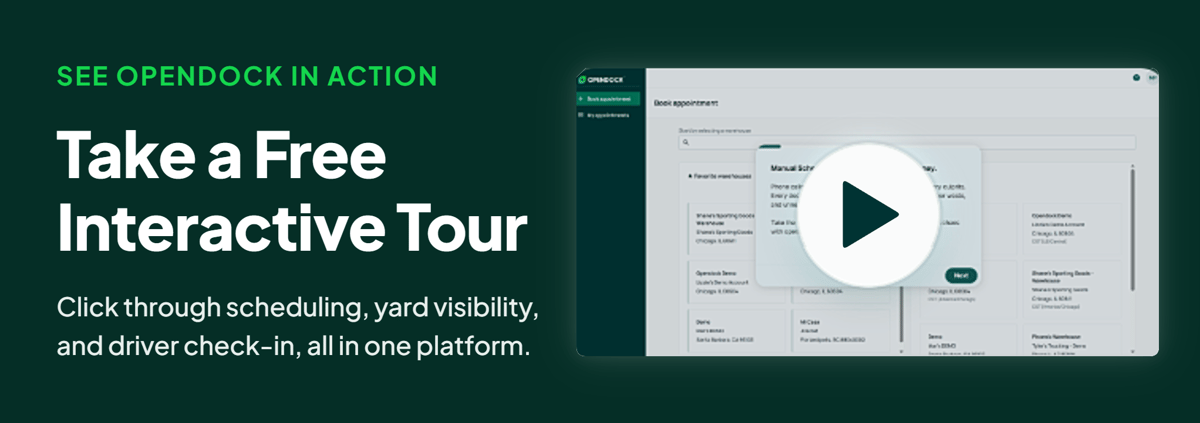
Digital BOL signing is one part of a connected gate workflow that also covers self-service dock scheduling, digital driver check-in, and live yard tracking. Taking the paper out of checkout is often what turns a mostly digital gate into a fully touchless one.

Frequently Asked Questions
Does Opendock's Digital BOL Integrate With My TMS?
Yes, ShipperGuide TMS integrates natively, and other TMS or WMS platforms can connect through Opendock's API and webhooks. In the native flow, the BOL originates in ShipperGuide and Opendock adds visit details such as arrival time, trailer number, and seal number before the driver signs.
How Does Driver Check-In Software Integrate With Dock Scheduling Systems?
In Opendock, driver check-in is linked directly to the scheduled appointment, so arrival, status updates, and the signed BOL all land on the same record. There's no separate system to reconcile, and the facility can see each visit move from scheduled to completed.
How Quickly Can We Implement Opendock's Digital BOL Signing?
Facilities already using Opendock for check-in and checkout can start right away with manual BOL uploads, at no additional cost. A fully automated WMS integration takes longer, and the timeline depends mainly on how quickly your WMS vendor can send documents and receive webhooks.