---
title: Protect Assets With Real-Time Dock Visibility | Opendock
description: Cargo tracking technology gives your dock real-time visibility and verified gate records, so cargo theft has nowhere to hide.
image: https://blog.opendock.com/hubfs/image%20(88)-1.png
---
[](https://blog.opendock.com/)
[](https://blog.opendock.com/)
- [Home](https://blog.opendock.com/)
- [Carrier Login](https://carrier.opendock.com/app/login)
- [Warehouse Login](https://nova.opendock.com/login)
More results
En
- English
- [Español - México](https://blog.opendock.com/es-mx/dock-visibility)
- [Português - Brasil](https://blog.opendock.com/pt-br/dock-visibility)
- [Home](https://blog.opendock.com/)
- [Carrier Login](https://carrier.opendock.com/app/login)
- [Warehouse Login](https://nova.opendock.com/login)
Opendock Blog
#### Share this
[Share on X](https://x.com/intent/post?url=https://blog.opendock.com/dock-visibility&text=Protect+Assets+With+Real-Time+Dock+Visibility+%7C+Opendock) [Share on Facebook](https://www.facebook.com/sharer/sharer.php?u=https://blog.opendock.com/dock-visibility&t=Protect+Assets+With+Real-Time+Dock+Visibility+%7C+Opendock) [Share on LinkedIn](https://www.linkedin.com/shareArticle?mini=true&url=https://blog.opendock.com/dock-visibility&t=Protect+Assets+With+Real-Time+Dock+Visibility+%7C+Opendock)
# How Real-Time Dock Visibility Protects Your Assets
by [**Lauren Platero**](https://blog.opendock.com/author/lauren-platero) on 16 February, 2026
Key Takeaways
- Cargo theft losses jumped 60% in 2025 to nearly $725 million.
- Blind spots at the dock and gate leave freight exposed to theft.
- Cargo tracking technology timestamps every gate and yard event.
- SmartGate turns each gate event into a verified, audit-ready record.
[Cargo tracking technology](https://opendock.com/en/products/yard-management/) gives warehouse teams real-time dock visibility, protecting valuable freight from theft, damage, and the delays that hold back operational performance.
The stakes are rising: estimated U.S. and Canadian cargo theft losses climbed 60% in 2025 to nearly $725 million. Automated gate verification and audit-ready records help teams close exposure gaps before they become losses.
[](https://opendock.com/en/products/smartgate/)
## **Why Does Real-Time Dock Visibility Matter for Asset Protection?**
Real-time dock visibility matters because what happens at the dock shapes risk, timing, and accountability across the entire supply chain. When dock activity isn't captured as it happens, teams react too late and assets are already at risk.
### How Does Poor Yard Visibility Affect Warehouse and Dock Operations?
Poor yard visibility creates the conditions theft needs. Delays in scheduling, gaps in verification, and fragmented communication give organized criminal networks windows to redirect freight, impersonate carriers, or exploit unmonitored access points.
[Verisk CargoNet's 2025 analysis](https://www.verisk.com/company/newsroom/cargo-theft-losses-surge-to-estimated-%24725-million-in-2025-verisk-cargonet-analysis-reveals/) shows the pattern clearly: it recorded 3,594 supply chain crime events across the U.S. and Canada, essentially flat from 2024, while confirmed cargo thefts rose 18% and estimated losses surged 60%.
Thieves are going after fewer, higher-value loads. For a look at how carrier impersonation creates theft risk, see [carrier vetting as a key step in theft prevention](https://blog.opendock.com/carrier-vetting).
### What Are the Most Common Yard Visibility Blind Spots Logistics Teams Face?
The most common blind spots are manual check-in processes, limited sightlines behind trailers, poor lighting, and time pressure that turns verification shortcuts into routine. High traffic and frequent driver turnover make those gaps harder to close, which is why [real-time yard visibility](https://blog.opendock.com/real-time-yard-visibility) starts with replacing manual records at the gate.
Food and beverage freight shows how quickly risk concentrates: CargoNet counted 708 food and beverage thefts in 2025, a 47% jump from 2024 and the largest increase of any commodity. For [food logistics operations](https://opendock.com/en/industries/food-logistics/) moving perishable, high-volume loads, every unverified gate event is a potential exposure.
## **How Does Cargo Tracking Technology Strengthen Dock Management?**
Cargo tracking technology strengthens dock management by capturing every on-site event automatically, with the precision and consistency manual processes can't match. As operations grow more complex, the gap between what teams can monitor by hand and what actually needs tracking widens quickly. Here's how technology closes it:
- Continuous tracking across dock events: Real-time visibility systems capture verified entry, yard movement, and departure events in a time-stamped record of on-site activity. Teams share one view of what's happening across every dock without manual updates or after-the-fact reconciliation.
- Accurate timestamps for loading and unloading: Time-stamped records let teams reconstruct events as they occurred, matching arrivals, dwell time, and departures against scheduled appointments. That clarity speeds investigations, resolves detention disputes, and supports compliance reviews with defensible proof. For a broader look at how accurate dock records reduce risk, see [using supply chain risk management software for dock records](https://blog.opendock.com/supply-chain-risk-management-software).
- Better coordination between dock, yard, and transportation: When gate, yard, and transportation systems share the same real-time view, carriers, warehouse teams, and transportation partners can coordinate without conflicting updates or follow-up calls to confirm status.
Each cargo tracking technology covers a different part of the journey. GPS stops being useful once a trailer reaches the facility, which is exactly where gate, yard, and dock systems take over.
| Technology | What it tracks | Where it covers |
| --- | --- | --- |
| GPS and telematics | Trucks and trailers in transit | Off-site; stops at the facility gate |
| Gate cameras and computer vision | Every vehicle entering and exiting, with time-stamped images | Entry and exit points |
| Digital driver check-in | Driver arrivals tied to appointments | The gate and check-in point |
| Yard management system | Trailer locations, moves, and status | Inside the yard |
| Dock scheduling | Appointment times and dock door activity | Dock doors |
## **What Role Does Real-Time Visibility Play in Preventing Asset Theft?**
Real-time visibility prevents asset theft by connecting cargo tracking with dock systems so teams can spot irregularities and act before losses occur.
### How Do Operations Managers Use Yard Visibility Dashboards to Make Real-Time Decisions?
Operations managers use live dashboards to act on anomalies before they become incidents. Unexpected arrivals, unscheduled access attempts, and [trailer dwell time](https://blog.opendock.com/trailer-yard-management-dwell-time) that runs past appointment windows surface right away, so supervisors can hold a truck, redirect a driver, or escalate to security while there is still time. That speed shrinks the window for theft and replaces after-the-fact investigation with early intervention.
### Clear Audit Trails for Investigations and Claims
Digital logs capture arrival times, vehicle IDs, and gate activity in a searchable, time-stamped record that investigators can access immediately. That clarity removes ambiguity from claims, speeds resolution, and gives teams the documentation needed to settle disputes with carriers, insurers, and partners.
The payoff shows up quickly. [A frozen food manufacturer](https://blog.opendock.com/case-study-frozen-food-manufacturer) cut damage claims by more than 95% after SmartGate began capturing time-stamped photos of every truck and load at arrival and departure.
[](https://loadsmart.navattic.com/8wv0bum?g=cmnt9pc3t000000ilch0b7gqp&s=1)
## **How SmartGate Enables Real-Time Dock Visibility**
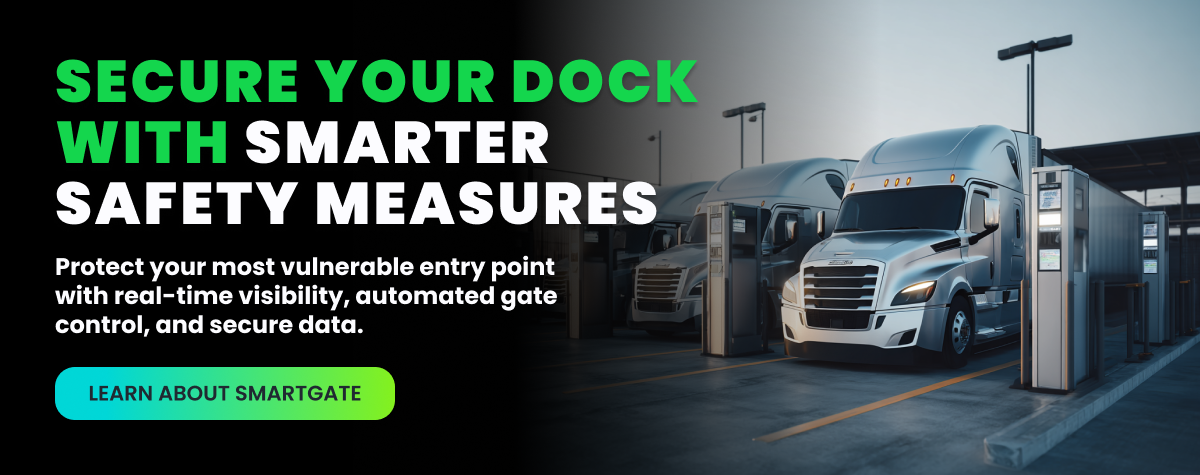
SmartGate automates gate verification, eliminates manual data entry delays, and gives teams real-time data for faster decisions at the gate. Here's what it delivers:
- Verified entry and exit events at the gate: SmartGate uses computer vision to capture vehicle and driver details at every entry and exit, creating a reliable, time-stamped audit trail of on-site activity. At [Westcoast Warehousing & Trucking](https://blog.opendock.com/case-study-westcoast-warehousing-and-trucking), SmartGate replaced manual check-ins and paper logs and gave staff real-time yard visibility to look up any container and send drivers straight to it. Nikesh Chand, Fleet & Facility Manager, summed it up: "SmartGate helps save time and money and I would recommend it to any warehouse operator."
- Arrivals tied to appointments: SmartGate verifies every vehicle and driver against its scheduled appointment, so arrival status and gate events sit alongside the dock schedule in Opendock. Supervisors see who has arrived and whether it matches the plan without chasing updates across separate systems.
- Reliable data for dock management: By removing manual data entry, SmartGate documents trucks and trailers as they arrive and depart. Time-stamped images, vehicle IDs, and gate activity logs give operations leaders what they need to spot unauthorized access, investigate irregularities, and manage dock flow with data instead of guesswork. For a look at how this data layer protects inventory, see [inventory loss prevention strategies for warehouses](https://blog.opendock.com/inventory-loss-prevention).
## **Protect Your Assets With Real-Time Dock Visibility**
Real-time dock visibility turns blind spots into documented, manageable checkpoints. When gate activity is automated, verified, and instantly searchable, theft has fewer places to hide and teams have more time to act. SmartGate delivers the coverage, accuracy, and audit trail dock operations need to protect assets on every shift.
[](https://opendock.com/#request-a-demo)
## **Frequently Asked Questions**
### What Does Yard Visibility Mean in Supply Chain Logistics?
Yard visibility means knowing, in real time, which trucks, trailers, and containers are on site, where each one sits, and what its status is. It covers the gate, the yard, and the dock doors, which is the stretch GPS stops covering once a trailer arrives at the facility.
### What Technologies Are Used to Improve Yard Visibility in Logistics Operations?
The main technologies are gate cameras with computer vision, digital driver check-in, yard management systems, dock scheduling, and GPS or telematics for freight in transit. GPS covers the road, while gate, yard, and dock systems cover what happens on site. Together, this cargo tracking technology gives teams a time-stamped record from arrival to departure.
### How Do Companies Get Real-Time Visibility Into Their Trailer and Container Yards?
Companies get real-time yard visibility by automating gate capture and tracking trailer locations digitally instead of on clipboards. An automated gate system like SmartGate records every vehicle that enters and exits, while a yard management system shows where each trailer or container sits and what its status is. With both in place, staff can look up any trailer instantly and direct drivers straight to it.
Topics: [SmartGate + Theft Prevention](https://blog.opendock.com/tag/smartgate-theft-prevention)
#### Share this
[Share on X](https://x.com/intent/post?url=https://blog.opendock.com/dock-visibility&text=Protect+Assets+With+Real-Time+Dock+Visibility+%7C+Opendock) [Share on Facebook](https://www.facebook.com/sharer/sharer.php?u=https://blog.opendock.com/dock-visibility&t=Protect+Assets+With+Real-Time+Dock+Visibility+%7C+Opendock) [Share on LinkedIn](https://www.linkedin.com/shareArticle?mini=true&url=https://blog.opendock.com/dock-visibility&t=Protect+Assets+With+Real-Time+Dock+Visibility+%7C+Opendock)
- Recent
- Topics
- Archive
Recent
Topics
- [Dock Scheduling (38)](https://blog.opendock.com/tag/dock-scheduling)
- [Gate Management (22)](https://blog.opendock.com/tag/gate-management)
- [YMS (18)](https://blog.opendock.com/tag/yms)
- [AI Warehouse Automation (17)](https://blog.opendock.com/tag/ai-warehouse-automation)
- [Case Study (17)](https://blog.opendock.com/tag/case-study)
- [AI Dock & Yard (16)](https://blog.opendock.com/tag/ai-dock-yard)
- [Pharmaceutical Logistics (16)](https://blog.opendock.com/tag/pharmaceutical-logistics)
- [Data Centers (12)](https://blog.opendock.com/tag/data-centers)
- [Opendock Blog (12)](https://blog.opendock.com/tag/opendock-blog)
- [Beverage Industry (10)](https://blog.opendock.com/tag/beverage-industry)
- [Reverse Logistics (10)](https://blog.opendock.com/tag/reverse-logistics)
- [SmartGate + Theft Prevention (10)](https://blog.opendock.com/tag/smartgate-theft-prevention)
- [Warehouse (8)](https://blog.opendock.com/tag/warehouse)
- [Digital BOL (7)](https://blog.opendock.com/tag/digital-bol)
- [Opendock (7)](https://blog.opendock.com/tag/opendock)
- [Shipper (7)](https://blog.opendock.com/tag/shipper)
- [CTPAT (4)](https://blog.opendock.com/tag/ctpat)
- [Dock Management (4)](https://blog.opendock.com/tag/dock-management)
- [Driver ID Validation (4)](https://blog.opendock.com/tag/driver-id-validation)
- [Podcast (4)](https://blog.opendock.com/tag/podcast)
- [Cargo Theft (3)](https://blog.opendock.com/tag/cargo-theft)
- [ShipperGuide TMS (2)](https://blog.opendock.com/tag/shipperguide-tms)
- [Asset (1)](https://blog.opendock.com/tag/asset)
- [Award (1)](https://blog.opendock.com/tag/award)
- [Blog (1)](https://blog.opendock.com/tag/blog)
- [Brokerage Services (1)](https://blog.opendock.com/tag/brokerage-services)
- [Data (1)](https://blog.opendock.com/tag/data)
- [Events (1)](https://blog.opendock.com/tag/events)
- [Opendock Index (1)](https://blog.opendock.com/tag/opendock-index)
- [PO Validation (1)](https://blog.opendock.com/tag/po-validation)
- [Thought Leadership (1)](https://blog.opendock.com/tag/thought-leadership)
- [eBooks (1)](https://blog.opendock.com/tag/ebooks)
See all
Archive
- [October 2026 (5)](https://blog.opendock.com/archive/2026/10)
- [September 2026 (1)](https://blog.opendock.com/archive/2026/09)
- [August 2026 (30)](https://blog.opendock.com/archive/2026/08)
- [July 2026 (1)](https://blog.opendock.com/archive/2026/07)
- [June 2026 (34)](https://blog.opendock.com/archive/2026/06)
- [May 2026 (11)](https://blog.opendock.com/archive/2026/05)
- [April 2026 (20)](https://blog.opendock.com/archive/2026/04)
- [February 2026 (48)](https://blog.opendock.com/archive/2026/02)
- [January 2026 (1)](https://blog.opendock.com/archive/2026/01)
- [November 2025 (1)](https://blog.opendock.com/archive/2025/11)
- [October 2025 (16)](https://blog.opendock.com/archive/2025/10)
- [September 2025 (7)](https://blog.opendock.com/archive/2025/09)
- [August 2025 (17)](https://blog.opendock.com/archive/2025/08)
- [July 2025 (3)](https://blog.opendock.com/archive/2025/07)
- [June 2025 (4)](https://blog.opendock.com/archive/2025/06)
- [April 2025 (1)](https://blog.opendock.com/archive/2025/04)
- [March 2025 (1)](https://blog.opendock.com/archive/2025/03)
- [February 2025 (2)](https://blog.opendock.com/archive/2025/02)
- [October 2024 (1)](https://blog.opendock.com/archive/2024/10)
- [August 2024 (1)](https://blog.opendock.com/archive/2024/08)
- [November 2023 (1)](https://blog.opendock.com/archive/2023/11)
- [October 2023 (2)](https://blog.opendock.com/archive/2023/10)
- [August 2023 (1)](https://blog.opendock.com/archive/2023/08)
- [May 2023 (2)](https://blog.opendock.com/archive/2023/05)
- [March 2023 (1)](https://blog.opendock.com/archive/2023/03)
- [February 2023 (2)](https://blog.opendock.com/archive/2023/02)
- [January 2023 (6)](https://blog.opendock.com/archive/2023/01)
- [July 2022 (1)](https://blog.opendock.com/archive/2022/07)
- [May 2022 (1)](https://blog.opendock.com/archive/2022/05)
- [March 2022 (1)](https://blog.opendock.com/archive/2022/03)
- [August 2021 (1)](https://blog.opendock.com/archive/2021/08)
See all
### Subscribe by email
#### **About Opendock**
Opendock is a simple and powerful cloud-based dock scheduling software for warehouses that want to improve dock performance. By connecting shippers, carriers, brokers to the same online scheduling platform, warehouses can reduce detention fees, labor costs, and time spent on phone calls and emails.
Product
- [Carrier Login](https://carrier.opendock.com/app/login)
- [Warehouse Login](https://nova.opendock.com/login)
- [Support](https://opendock.com/support/)
- [Request a Demo](https://opendock.com/#request-a-demo)
Resources
- [ROI Calculator](https://opendock.com/#roi-calculator)
- [Community](https://community.loadsmart.com/hc/en-us/categories/14812430603411-Warehouses)
- [Developers API](https://developer.loadsmart.com/docs/opendock/overview/getting-started/)
Opendock is Powered by Loadsmart Inc. © 2026 - All rights reserved. SOC2 Type II.
- [Terms and Conditions](https://loadsmart.com/subscription-and-professional-services-agreement/)
- [Privacy Policy](https://loadsmart.com/privacy-policy/)
- [Security](https://lp.loadsmart.com/security)
```json
{
"@context" : "https://schema.org",
"@type" : "BlogPosting",
"author" : {
"@type" : "Person",
"name" : "Lauren Platero",
"url" : "https://blog.opendock.com/author/lauren-platero"
},
"dateModified" : "2026-10-14T17:45:03.207Z",
"datePublished" : "2026-02-16T19:41:16.000Z",
"headline" : "Protect Assets With Real-Time Dock Visibility | Opendock",
"image" : [ "https://blog.opendock.com/hubfs/image%20(88)-1.png" ],
"mainEntityOfPage" : {
"@id" : "https://blog.opendock.com/dock-visibility",
"@type" : "WebPage"
},
"publisher" : {
"@type" : "Organization",
"logo" : {
"@type" : "ImageObject",
"url" : "https://blog.opendock.com/hubfs/ls-logo.png"
},
"name" : "Loadsmart"
}
}
```
```json
{
"@context" : "https://schema.org",
"@type" : "FAQPage",
"mainEntity" : [ {
"@type" : "Question",
"acceptedAnswer" : {
"@type" : "Answer",
"text" : "Yard visibility means knowing, in real time, which trucks, trailers, and containers are on site, where each one sits, and what its status is. It covers the gate, the yard, and the dock doors, which is the stretch GPS stops covering once a trailer arrives at the facility."
},
"name" : "What Does Yard Visibility Mean in Supply Chain Logistics?"
}, {
"@type" : "Question",
"acceptedAnswer" : {
"@type" : "Answer",
"text" : "The main technologies are gate cameras with computer vision, digital driver check-in, yard management systems, dock scheduling, and GPS or telematics for freight in transit. GPS covers the road, while gate, yard, and dock systems cover what happens on site. Together, this cargo tracking technology gives teams a time-stamped record from arrival to departure."
},
"name" : "What Technologies Are Used to Improve Yard Visibility in Logistics Operations?"
}, {
"@type" : "Question",
"acceptedAnswer" : {
"@type" : "Answer",
"text" : "Companies get real-time yard visibility by automating gate capture and tracking trailer locations digitally instead of on clipboards. An automated gate system like SmartGate records every vehicle that enters and exits, while a yard management system shows where each trailer or container sits and what its status is. With both in place, staff can look up any trailer instantly and direct drivers straight to it."
},
"name" : "How Do Companies Get Real-Time Visibility Into Their Trailer and Container Yards?"
} ]
}
```