
Share this
by Darrion Edwards on 24 August, 2026
Key Takeaways
- Manual dock scheduling causes congestion, missed slots, and detention fees.
- FMCSA data shows drivers face detention on about 1 in 10 stops.
- Self-service scheduling lets carriers book dock slots without phone calls.
- Automated rules and reminders cut wait times and manual coordination.
Few things are more harmful to a warehouse's relationship with a carrier than long wait times. Unlike transparent factors such as lanes and rates, wait times are an unexpected and often unpredictable variable that can hold up a carrier's trucks at a particular facility. Even with demurrage charges in place to discourage wait times, carriers still have to grapple with wait times impacting their overall operations.
This is why dock managers and supervisors are increasingly turning to dock scheduling software to streamline operations at their facilities. In an industry where relationships are everything, dock managers and supervisors have to consider whether tools will help benefit not only them, but their carriers too.
The tooling underneath is changing as well: scheduling software has spent a decade getting better at preventing bad appointments, and it's now getting better at fixing them once the day has already gone sideways.
In this post, we'll outline exactly how loading dock appointment scheduling can be improved with the right software, and why reducing truck wait times matters as much to your carriers as it does to your own operation.
How Do You Actually Reduce Truck Wait Times at the Dock?
The most direct way to reduce truck wait times is with automated, self-service dock scheduling that gives carriers real visibility into appointment windows. A 2014 study from the Federal Motor Carrier Safety Administration (FMCSA) found that drivers experience detention time at approximately 1 in every 10 stops, for an average of 1.4 hours beyond the standard two-hour loading and unloading window, putting them at the facility for roughly 3.4 hours in total. Facilities aren't allowing this to happen willingly, not when there are detention and demurrage fees and reputational costs attached to every one of those hours.
What's far more likely is that facilities are getting overwhelmed by the common pitfalls of manual dock scheduling: congestion, subpar coordination, and unplanned arrivals. Particularly with unplanned arrivals, dock managers and supervisors can go from a relaxed morning to an afternoon filled with detention fees, dock idle time, and untenable labor spikes, which is the pattern behind most of the challenges of not using a dock scheduling system.
Prior to switching to Opendock's dock scheduling software, International Auto Processing (IAP) scheduled inbound freight at its Port of Georgia facility on a first-come, first-served basis, with up to 8 to 10 full truckloads showing up unannounced on bad mornings and up to four staff members routinely pulled away from their core responsibilities to manage the chaos.
Once IAP made the switch, it achieved 95% carrier self-scheduling, capped daily inbound volume at five trucks with a 1.5-hour unloading window each, and brought unscheduled arrivals down to less than 5%. The four staff members who used to be pulled into dock management full-time went back to their core roles.
How Smart Dock Scheduling Systems Work
There are a few key features that make loading dock management software intuitive, effective, and valuable.
- Carrier self-service portal: the biggest boon to a dock manager's relationship with carriers is the ability to offer a self-service portal. This unlocks automated dock time slot scheduling, where carriers can view available windows and book within your rules, without back-and-forth emails or phone calls.
- Configurable appointment rules: loading dock appointment scheduling tools empower warehouse operators as much as they do carriers. Users can configure custom rules for time windows, load type restrictions, and advance booking requirements.
- Automated confirmations and reminders: this functionality reduces no-shows without manual follow-up, sending automatic confirmations and reminders that improve communication on both ends of the warehouse-carrier relationship.
What Do Carriers and Operations Teams Experience with Dock Scheduling Software?
Carriers and operations teams both get more predictability, since self-service booking removes phone-tag on one side and gives real-time exception alerts on the other. Dock managers and supervisors sometimes worry about how carriers will respond to an appointment portal, but the adoption numbers at facilities like IAP show why the concern doesn't usually hold up.
On the carrier side, self-service booking is appreciated because it reduces hassle for everyone involved. Carriers get full transparency into availability and capacity at your facility, and if a slot is open to book, they have a reasonable expectation that your team will be ready for their truck when it arrives. Some driver check-in tools also add real-time dock status, so carriers can track progress without calling ahead.
For operations teams, a live dock calendar keeps everyone aware of arrivals and departures. Exception alerts for late arrivals make it easier for teams to adjust to scheduling shifts rather than reacting after the fact.
After switching to electronic dock scheduling, GoBolt, a tech-enabled fulfillment and 3PL provider, improved inbound receiving efficiency by 20% and cut 10 to 15 hours per week of administrative work that used to go into coordinating trucks by phone and email.
How Is AI Changing Dock Appointment Scheduling and Rescheduling?
AI is moving dock scheduling from booking appointments to repairing them mid-day, rebooking and notifying carriers automatically the moment a slot stops being realistic. Most wait time is not caused by a bad schedule. It is caused by a good schedule that stopped being true at 10 a.m. A pickup runs late, the next three appointments compress, and the queue forms while someone is still on the phone finding out what happened.
Rule-based scheduling cannot solve this, because a rule is written in advance and the problem is happening now. The emerging alternative is software that senses the change, decides whether the appointment needs to move under the facility's own rules, and executes the rebooking and the notification without waiting for someone to notice.
Across the industry this is furthest along for the mechanical cases: a carrier that has not shown, a window that has expired, a slot that needs to be released. It is much less mature for the judgment calls, and realistically stays that way. Where facilities want their own systems to participate, a dock scheduling API and MCP server is what lets an agent read availability and act on it directly.
How Can Warehouse Operators Use AI Agents to Reduce Truck Detention Time?
By closing the gap between the moment a schedule slips and the moment someone acts on it, which is where most detention is actually created. Opendock is part of the Loadsmart Platform and benefits from Loadsmart AI. The Scheduling & Rescheduling AI agent books against live carrier and facility availability, and when a pickup slips it reschedules and notifies every party involved, including no-show and grace-period handling. That saves 5 to 10 minutes per appointment, most of it the phone-and-email time that used to sit between a delay and a fix.
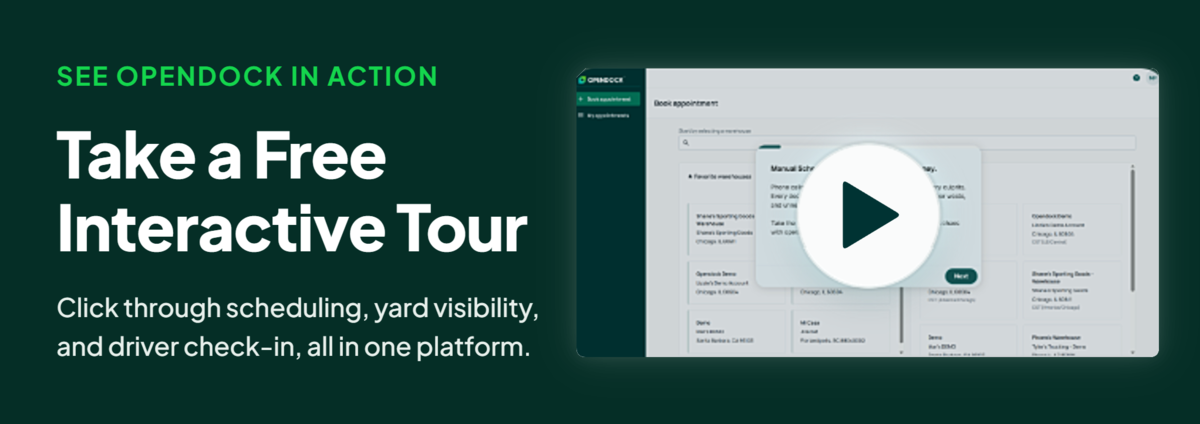
See How Opendock Schedules the Loading Dock
Your choice of a dock scheduler for your warehouse affects you and your carriers both, which is why we encourage dock managers to take advantage of any demos a prospective tool offers before making the leap.
A closer look at features like automated dock scheduling, driver check-in, and automated arrival and departure logs makes it easier to see whether a given platform fits your facility. For a fuller breakdown of what to weigh, see Dock Appointment Scheduling Software: The Essentials.
Facilities that have already made the switch tend to point to the same reasons: fewer detention fees, less time on the phone, and a dock day that unfolds closer to plan than to chaos.

Frequently Asked Questions
How Does Loading Dock Scheduling Reduce Carrier Wait Time?
It replaces first-come, first-served arrivals with fixed appointment windows, so trucks show up when a dock and crew are actually ready for them. Combined with configurable rules and real-time status, this is what took IAP's unscheduled arrivals down to less than 5%.
Can Carriers Book Their Own Dock Appointments Without Calling?
Yes. A carrier self-service portal lets carriers view open windows and book, reschedule, or cancel appointments directly, without a call or email to your team. That's the same capability that drove GoBolt's 20% gain in inbound receiving efficiency.
How Can AI Agents Automate Dock Scheduling at Distribution Centers?
Mainly on the recovery side rather than the booking side. Rules and capacity limits are configured by your team, and AI agents connected to a dock scheduling platform act when the schedule slips: rebooking the appointment, releasing the slot, and notifying the carrier automatically.